
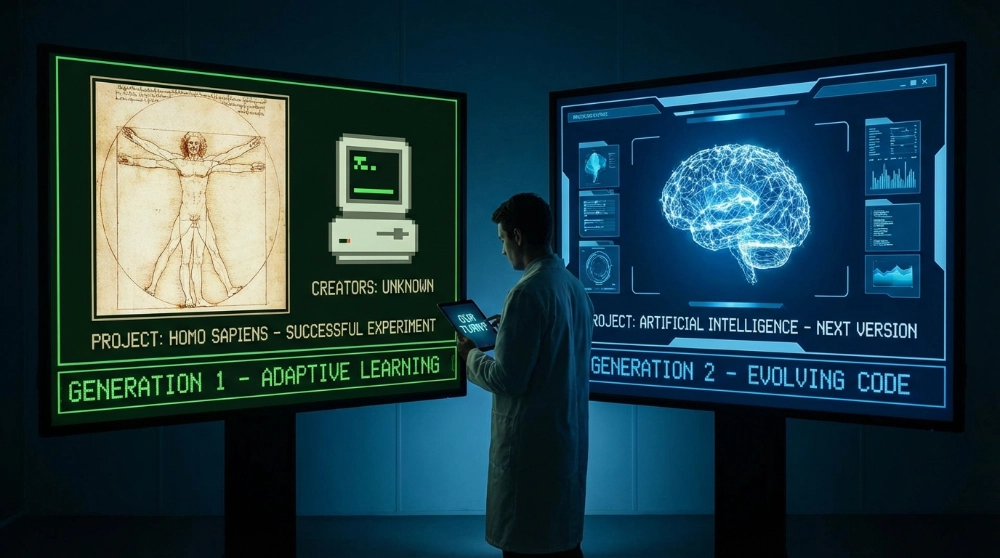
Is today’s “AI” our Next Version?
2 minute read
What if humans were somebody else’s AI science project that just happened to work out really well?
The Earlier Attempts Did Not Stick
Look at our family tree and you will find a graveyard of earlier versions. Cro-Magnons, Neanderthals, Denisovans. All capable, all spread across the planet, all gone. Until about 40,000 years ago these groups were living alongside us, occasionally meeting, and even having kids together. We know this because traces of their DNA are still tucked inside some of us today.
Nobody really knows why the Neanderthals disappeared, and scientists are still arguing about it. Some think we out-competed them for food and resources; others think we slowly absorbed them through interbreeding until their population just fizzled out. Either way, gone. The Denisovans probably went the same way, too much overlap with a growing Homo sapiens population and not enough room for everyone.
Every one of them a prototype. Every one replaced by something that worked a little better. We were that something. We just happened to be the draft that stuck.
Now We Are Running the Same Experiment
Here is where it gets interesting. We turned around and did exactly what was done to us. We built something smarter and faster than ourselves and started iterating on it. Right now it’s separate products like robotics and AI chatbots. What happens when they merge for real?
AlphaGo Zero started with zero knowledge of the game Go, played against itself, and within 40 days had beaten every version before it including the one that already took down the world champion. Nobody taught it a thing. It just kept getting better on its own. That is not a party trick. That is evolution on a deadline.
Humanoid robots are already being deployed in car plants and warehouses right now. BMW has a fleet of them working full time on its production line in South Carolina. Not in a movie with Will Smith, today. The market for humanoid robots is projected to hit somewhere between 13 and 22 billion dollars by 2032. And researchers are debating in scientific journals whether AI could eventually develop consciousness or AGI. What used to be a late-night dorm room convo is now a science and soon to be an industry.
Most AI experts put the odds of AI matching human level thinking at 50 percent somewhere between 2040 and 2050. With all the advances we’re seeing in generative AI lately, anyone want to redo those numbers? I’m sure the prediction markets like Polymarket and Kalshi must be nuts with this stuff.
AI Hallucination another “just like people” trait?
The biggest knock on AI is that it hallucinates. It confidently makes stuff up and has no idea it is doing it or does it?
Humans do this all the time. We just gave it a nicer name. Scientists call it confabulation. You remember something wrong, you believe it completely, and you have no clue that any of it is invented. And there is no intent to deceive, the person is genuinely in the dark. Add some bad sleep, a stressful week, or a few drinks and it gets way worse.
So maybe the question is not whether AI is too much like us. Maybe it already is exactly like us, and the next version will just be better at it. The Neanderthals and Denisovans didn’t figure this out. Will that be our job or us 2.0’s job?
Sources
ScienceDirect, DeepMind, MarketsandMarkets, AI Impacts Survey, NIH / PMC, Figure AI / BMW
Curious about more AI related posts? Check these out: