
3 minute read
The Backflips Are Over
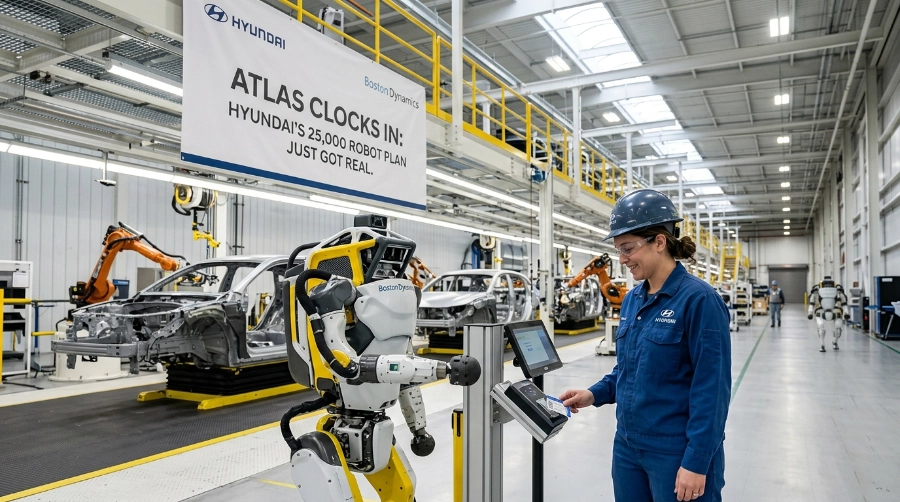
Remember when Atlas was the robot doing parkour while the rest of us watched on our phones and laughed a little nervously? Those days are done. Boston Dynamics just opened a training center called RMAC inside Hyundai’s Metaplant America campus near Savannah, Georgia, and Atlas is now practicing actual car factory work. Moving tires. Sorting parts. Sequencing lines. Very glamorous.
About That 25,000 Number
Quick reality check, because the headlines are getting a little excited. Hyundai is not dropping 25,000 robots onto factory floors this week. That’s the target for Hyundai and Kia plants worldwide over the next few years, backed by a new US factory that can crank out 30,000 robots a year. Right now Atlas is in school, and human trainers are still teleoperating it to teach it the job. Real line work at Metaplant America is planned for 2028, starting with parts sequencing, with full component assembly targeted by 2030.
The Price Tag Is Shrinking
Boston Dynamics says it cut the cost of some Atlas components by 60 to 80 percent going from prototype to production. Note the word “some.” Nobody has published a sticker price yet. But cheaper robots have a funny way of showing up in more places.
Meanwhile, the Competition
Tesla’s Optimus Gen 3 still hasn’t had its big public reveal. In July, Tesla said Optimus lines were being installed at Fremont with production expected later this year. Maybe we hear more on the October 21 earnings call. Maybe we get another video. Over in China, XPeng’s IRON walked off its shiny new production line under its own power back in early September. Cool moment, but mass production isn’t due until the end of 2026 and customer deliveries are a 2027 thing. So for now, Atlas is the humanoid with an actual factory job lined up. Helps when your parent company owns about 80% of you and the factory too.
So What Happens to the People?
This is the part that matters if you work a line. Atlas can lift 110 pounds at peak, carry 66 pounds steady, runs about four hours, and swaps its own batteries so it never really clocks out. It’s built for the heavy, repetitive, back-wrecking jobs. Hyundai swears Atlas is a coworker, not a replacement, and says humans will still be needed to run, train, and fix the fleet. Workers in Korea aren’t totally sold. Hyundai’s union there said back in January that Atlas wasn’t getting through the door without a labor agreement.
Your New Job Description
If this works, a lot of the jobs left behind start to look like robot babysitting. Training them. Maintaining them. Catching them when they mess up. Sound familiar? Same deal as the AI agents on your laptop, just with 56 degrees of freedom and the ability to drop a transmission on your foot.
Stay Useful, Stay Loud
The smart move for American factory workers isn’t panic. It’s getting close to the machines. Learn how they’re trained, learn how they fail, and be the person in the room when management decides what Atlas does next. Robots don’t negotiate contracts. People do.
Sources: Boston Dynamics, Interesting Engineering, Korea JoongAng Daily, Digital Trends, Forbes, Tech Times, Tesla, XPeng